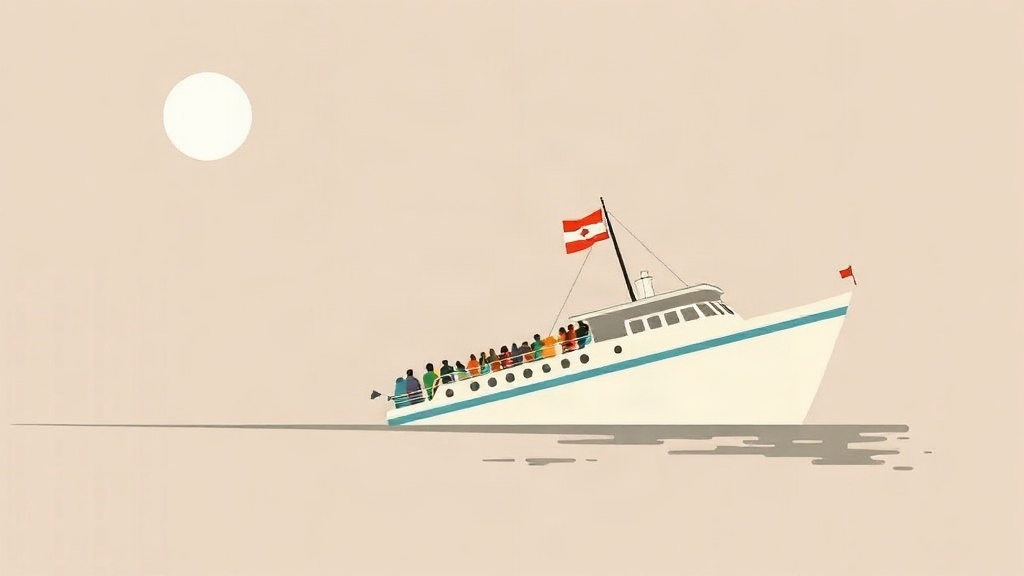
Death Toll Mounts After Djibouti Shipwreck
At least 109 migrants are dead — among them 15 children — and 116 people remain missing after an overcrowded boat capsized off the coast of Djibouti late Thursday night, the International Organization for Migration (IOM) has confirmed [1]. Around 80 people were rescued from the water, out of an estimated 350 who were on board when the vessel went down near Obock, a port town in northern Djibouti [1].
The IOM said recovered bodies included 52 men, 42 women, nine girls, and six boys [1]. All survivors identified so far are Ethiopian nationals, and local authorities have made medical care available to them while also arranging burials for the dead [1].
A Deadly Route That Runs Toward War
The boat's intended destination makes the tragedy all the more striking: it was heading toward Yemen, a country that has been consumed by civil war for more than a decade [1]. Yet for tens of thousands of migrants from the Horn of Africa, Yemen is not a destination to avoid — it is a waypoint, a corridor toward the Gulf states where the prospect of work and relative safety outweighs the dangers of the crossing and the conflict on the other side [1].
The stretch of water between Djibouti and Yemen, known as the Bab el-Mandeb Strait, is one of the world's most heavily trafficked migration corridors and one of its most lethal. Migrants who attempt it are typically fleeing a combination of poverty, insecurity, and the accelerating effects of climate change across the Horn of Africa [1].
The scale of movement along this route has been significant in recent weeks. The IOM's Displacement Tracking Matrix recorded more than 20,000 individual movements from Ethiopia to Djibouti between September 10 and the date of the disaster [1] — a figure that underscores how consistently people are funneling into this corridor despite its well-documented dangers.
"A Stark Reminder"
Alexandre Coissac, the IOM's mission chief in Djibouti, described the sinking as "a stark reminder of the dangers migrants face while seeking a new life elsewhere" [1]. In a statement released Friday, he added: "This is a devastating loss of life. Our thoughts are with the survivors and the families who have lost loved ones or remain without news of their relatives." [1]
The language is measured, but the numbers are not. With 116 people still unaccounted for, the final death toll could rise considerably. Search and rescue operations were ongoing at the time of reporting, though the prospects for survivors diminish rapidly in open water.
Children Among the Victims
The presence of children among the dead — six boys and nine girls confirmed recovered — points to the desperation driving these journeys [1]. Families, not just individuals, are making the calculation that a dangerous sea crossing toward a war zone offers better odds than staying home.
That calculation is shaped by conditions across Ethiopia and the broader Horn of Africa region, where drought, displacement, and economic collapse have pushed millions into precarious circumstances. The IOM has consistently documented this corridor as one of the busiest mixed-migration routes in the world, with the flow showing little sign of slowing despite repeated tragedies.
A Crisis With No Easy Off-Ramp
Thursday's sinking is not an isolated incident. The Bab el-Mandeb route has claimed lives repeatedly in recent years, and humanitarian organizations have long warned that without addressing the root causes driving migration — poverty, climate stress, conflict — the crossings will continue regardless of the risks involved.
Yemen itself offers little safety for those who make it across. The country's civil war, now in its second decade, has created one of the world's worst humanitarian crises, with millions facing food insecurity and limited access to basic services. Yet for migrants transiting through, Yemen functions as a bridge rather than a final stop, with Gulf countries — particularly Saudi Arabia — as the ultimate goal.
The structural tension is difficult to resolve: the very instability that makes the journey so dangerous is also part of what makes staying behind feel untenable for those who attempt it.
What to Watch
In the coming days, the key questions will be whether search and rescue efforts recover additional survivors — or more bodies — and whether the final death toll surpasses the 109 confirmed so far. The IOM is expected to provide updated figures as operations continue.
More broadly, this disaster is likely to renew pressure on regional governments and international bodies to expand safe and legal migration pathways and to increase humanitarian presence along the Djibouti-Yemen corridor. Whether that pressure translates into action, as opposed to statements of condolence, remains the harder question.