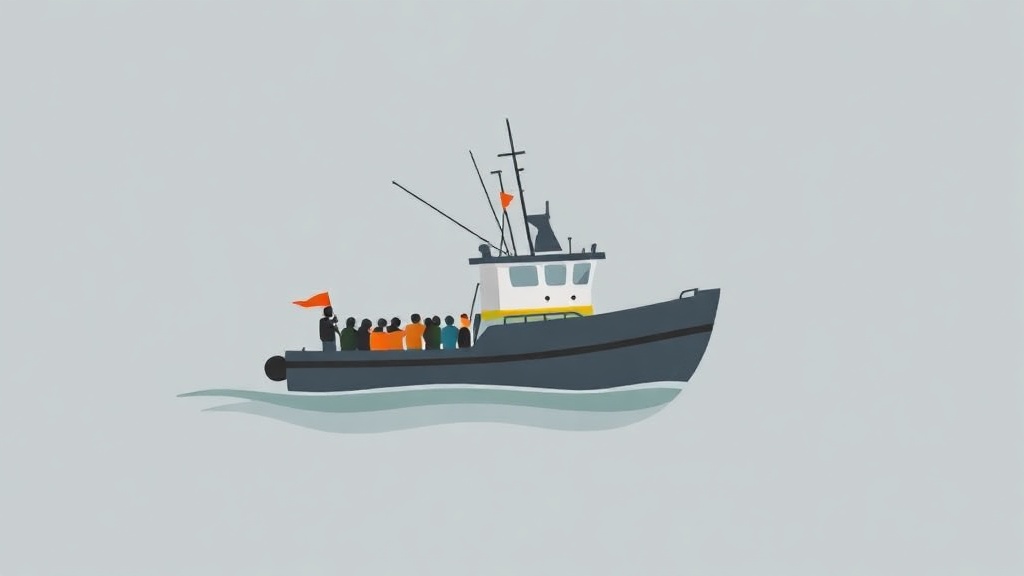
A migrant vessel attempting to cross the English Channel from France to the United Kingdom caught fire on Tuesday morning, triggering a major rescue operation that pulled 157 people from the water and the stricken boat — with no fatalities or injuries reported [1].
The incident unfolded in waters near the French port of Boulogne-sur-Mer, where the boat had been in difficulty since the previous night [2]. It adds fresh urgency to one of the most politically charged issues in British politics, arriving just one day after Prime Minister Andy Burnham pledged his government would be "relentless" in curbing small-boat crossings [1].
What Happened on the Water
The boat left France on Monday night, according to the French maritime prefecture of the Channel and North Sea [1]. Overnight, five of those on board requested and received assistance from French patrol boats, but the remaining passengers refused help — reportedly determined to continue their journey to the UK [1][2].
French authorities cited the "structural fragility" of the vessel as a reason they did not intervene more forcefully at that stage [1]. By Tuesday morning, however, the engine caught fire and, in the words of the French maritime prefecture, "the vessel's integrity deteriorated very rapidly" [1].
A joint rescue operation then launched from both sides of the Channel. French vessels recovered 103 of those on board, while British assets — including the RNLI Eastbourne lifeboat and UK Border Force vessels BSC Contender and BSC Courageous — rescued the remaining 54 [1]. All 157 survivors were brought to port in Boulogne-sur-Mer for treatment [1][2]. Some passengers had jumped into the sea before being recovered [2].
The Political Backdrop
The rescue comes at a particularly sensitive moment in British politics. Burnham, who became prime minister just a fortnight ago, visited Dover on Monday and acknowledged that "people want to see this issue addressed," while pointing to a doubling of enforcement officers tackling people-smuggling gangs on both sides of the Channel [1].
More than 2,000 migrants have crossed the Channel in small boats since Burnham took office [1][2]. Last Wednesday alone saw 752 arrivals — the busiest single day for crossings so far this year [1]. Despite that, Home Office figures show overall crossings in 2026 are running approximately 43% lower than at the same point last year, continuing a downward trend that began after the 2022 peak [1].
In April, the UK and France signed a £662 million deal — spread over three years — aimed at halting illegal crossings. The agreement includes riot-trained police on French beaches, drone surveillance, and helicopter deployments to intercept smugglers and migrants [1]. UK ministers have indicated that around £100 million of that funding could be redirected or withdrawn after a year if crossing numbers do not fall sufficiently, though the government has not confirmed the specific targets France must meet [1].
Opposition Voices and Legal Context
The fire has predictably reignited political debate. Shadow Home Secretary Chris Philp argued that "French police stand by and do nothing while the illegal migrant boats embark," calling the situation dangerous [1]. Reform UK leader Nigel Farage posted on X that "we must put a stop to this," claiming his party's plan "will save lives" — a reference to Reform's proposal to deploy the Royal Navy to ward off crossings, as well as its pledge to abolish indefinite leave to remain if it wins the next election, due in 2029 [1][2].
The Liberal Democrats, by contrast, called on the government to deepen European cooperation and reduce the asylum application backlog [1].
Underlying the political argument is a structural legal tension. Under current UK rules, people cannot make asylum claims from overseas — they must be physically present in the UK to lodge an application [2]. Amnesty International has argued this makes it "impossible" for people abroad to seek asylum through legal channels [2]. The 1951 UN Refugee Convention, to which the UK is a signatory, explicitly recognises that those fleeing persecution may have to use irregular routes [2].
Burnham himself acknowledged this tension on Monday, saying that alongside enforcement, "a system that offers safe routes for people" needs to be built [1].
What to Watch
Several threads will determine how this story develops in the coming weeks. Whether France meets the performance benchmarks tied to the £662 million bilateral deal will be a key test of whether the financial incentive is changing behaviour on French beaches [1]. The government's reluctance so far to specify those targets publicly leaves the accountability mechanism unclear.
The political pressure from Reform UK — whose naval deployment proposal and ILR abolition pledge are now part of the mainstream debate — will intensify if crossing numbers rise as summer conditions improve [1][2]. And the broader question of safe legal routes, raised by Amnesty International and implicitly by Burnham himself, remains unresolved, with no concrete policy announced to address it [1][2].
Tuesday's fire, in which everyone survived, could easily have ended differently. The French maritime prefecture's own account — of passengers refusing help overnight, only accepting rescue when the boat was actively burning — underscores the desperation that drives people into structurally fragile vessels, and the limits of any enforcement-only response.