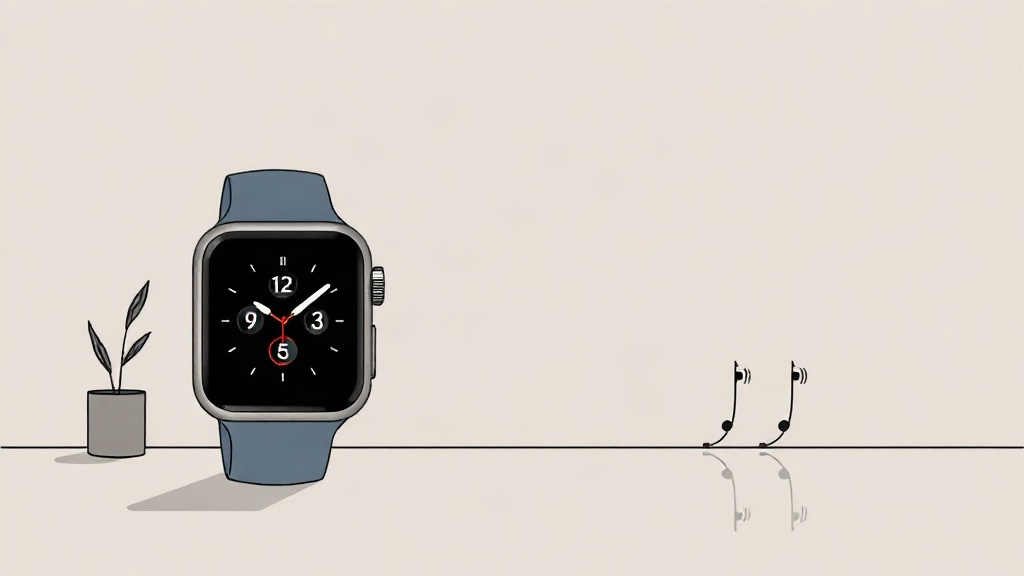
Apple unveiled the Apple Watch Series 12 and Apple Watch Ultra 4 on September 9th at its "Surprise and Shine" event in Cupertino, positioning the new wearables squarely against a growing field of AI-focused competitors with a suite of listening and memory features it calls Audio Intelligence [3].
A Wearable That Listens — and Remembers
The headline additions are two ambient-audio features that together aim to make the Apple Watch a kind of passive memory aid. Live Rewind lets users replay the previous 15 seconds of nearby audio: a double-press of the Digital Crown surfaces a text transcript of the snippet on-screen [1]. From there, users can ask Siri questions about the content or save the transcript to the new Siri app for later review [3].
The second feature, Siri Recap, goes further. When enabled, it uses ambient listening to monitor conversations throughout the day — a team meeting, a parent-teacher conference, a casual exchange — and automatically generates a titled summary with key points inside the Siri app [3]. Apple's pitch is that users can "be more present and engaged in the moment" rather than scrambling to take notes [1].
Apple says neither feature creates or stores audio recordings [3]. Both Live Rewind and Siri Recap will arrive in beta later this year, initially in English only, on both the Series 12 and the Watch Ultra 4 [1].
Sound Recognition Comes to the Wrist
Rounding out the Audio Intelligence package is Sound Recognition, a feature that has existed on iPhone but now runs independently on the watch itself [1]. It listens for sounds like sirens, alarms, doorbells, and a baby crying, then notifies users who are deaf or hard of hearing — even when their iPhone is not nearby [1]. The on-device processing emphasis is consistent with Apple's broader privacy framing for all three audio features [3].
A fourth audio addition is more straightforward: Shazam integration now surfaces song titles and artist names automatically in a Music Recognition widget within the Smart Stack, readable at a glance on the wrist [1].
Hardware: Heart Health Gets a Major Upgrade
While the audio features dominate the announcement, the Series 12 also brings meaningful health-sensing improvements. Both the Series 12 and Ultra 4 feature redesigned optical sensors — photodiodes arranged in a ring formation to capture light more efficiently — alongside more power-efficient green LEDs that maintain accurate heart-rate readings even during movement [3].
The practical result is a dramatic increase in monitoring frequency: background heart rate readings are now taken every five seconds throughout the day, a rate 60 times more frequent than on previous models [1][3]. Apple frames this continuous data stream as "a key indicator of your overall health" [3].
New to both watches are Readiness Scores, which synthesize recent activity, vitals, and sleep data each morning into a single number indicating how prepared the body is for the day — an approach that mirrors features already popularized by dedicated smart rings [3]. A Health Age metric also makes its debut, comparing a user's key health indicators — including VO2 max and sleep data — against their chronological age [3].
The Series 12 additionally expands its Cycle Tracking experience to include support for perimenopause and menopause, and the new electrical heart sensors support improved ECG readings through an increased electrode surface area [1][3].
Chip, Colors, and Pricing
Under the hood, the Series 12 runs on Apple's new S11 chip [1]. It comes in space gray, black, gold, and bronze, as well as black and white ceramic finishes [1]. The watch starts at $399 — a price Apple has held steady on its base model for several years, even as a broader wave of price hikes hit most of its other product lines earlier this year [1].
Preorders opened September 9th, with availability beginning September 18th [1]. Apple is also offering the Series 12 through its Upgrade leasing program, with 12- and 24-month options starting at $11.99 per month [1]. The Apple Watch Ultra 4 carries a starting price of $499 [3].
A New CEO's First Hardware Moment
The launch carries a notable corporate footnote: it is among the first major product releases under Apple's new CEO, John Ternus, who officially took the role on September 1st [1]. Ternus previously led Apple's hardware engineering division, where he directly oversaw Apple Watch development — giving him an unusually hands-on connection to the product line he is now debuting as chief executive [1].
What to Watch Next
The most consequential question is whether Live Rewind and Siri Recap will clear Apple's own bar for release. Both features are slated for beta only, with no firm launch date beyond "later this year," and English-language support exclusively at first [1]. How Apple handles user privacy concerns around ambient listening — and whether regulators in Europe or elsewhere scrutinize the always-on audio model — will shape how broadly these features ultimately roll out. The competitive response from Samsung, Google, and the crop of dedicated AI wearable startups is also worth tracking: Apple has now drawn a clear line in the sand around the wrist as a platform for passive AI assistance.