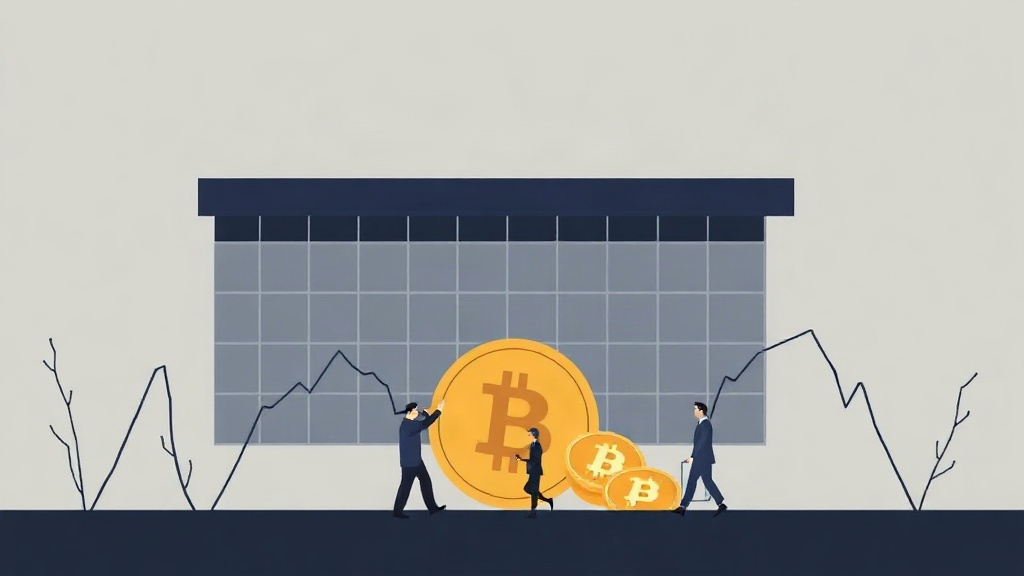
Bitcoin's price trajectory through the end of the decade is one of the most debated questions in finance, and for good reason: the range of credible outcomes spans from a catastrophic bust to a seven-figure valuation. Rather than chasing a single number, analysts at The Motley Fool argue that investors are better served by thinking in terms of a probability spectrum—best case, base case, and worst case—each grounded in distinct assumptions about adoption, regulation, and Bitcoin's own cyclical history [1].
The Bull Case: $1 Million Per Coin
The optimistic end of the spectrum puts Bitcoin at or above $1 million by the close of 2030 [1]. That figure may sound like fantasy, but it has notable backers. Cathie Wood of Ark Invest has projected Bitcoin trading as high as $1.2 million within a few years, and Jack Dorsey of Block has also publicly endorsed the $1 million target, as have other Silicon Valley entrepreneurs [1][2].
Reaching that level would require a confluence of powerful catalysts. The first is legislative: the passage of the Digital Asset Market Clarity Act, which proponents say would make it significantly easier for investors to buy, hold, and trade Bitcoin [1][2]. The second is structural: a broad shift in wealth management culture, where investment advisors begin recommending clients allocate at least 1% of their portfolios to Bitcoin [1]. That seemingly small allocation, multiplied across the trillions of dollars managed by financial advisors, would funnel a sustained stream of new capital into spot Bitcoin ETFs and exert steady upward pressure on price [2].
This is analysis, not settled fact—whether regulatory momentum and advisor adoption materialize on that timeline remains genuinely uncertain.
The Base Case: $300,000 by 2030
The most likely scenario, according to the analysis, centers on Bitcoin sustaining the growth rate it has already demonstrated over the past decade. From August 2017 to July 2026, Bitcoin compounded at an annual growth rate of 33% [1][2]. Applying that same CAGR to a starting price of roughly $100,000 at the end of 2026 produces a figure of approximately $300,000 by the end of 2030 [1].
That projection has high-profile support. Coinbase CEO Brian Armstrong has said it is "very likely" that Bitcoin reaches $300,000 by 2030, a view he connects directly to the cryptocurrency's historical growth trajectory [1][2].
The caveat is one that serious analysts never omit: past performance is not a guarantee of future results. Bitcoin's 33% CAGR was achieved during a period of rapid adoption from a relatively small base. Whether that rate can persist as the asset matures and its market capitalization grows is an open question. Still, the base case is notable for being the one scenario where the math is anchored in observable history rather than speculative adoption curves.
The Worst Case: A Cyclical Crash in 2030
Bitcoin's history is not a straight line upward—it is a series of dramatic booms followed by equally dramatic busts. The pattern, as the analysis describes it, has been remarkably consistent: roughly three strong years followed by one severe down year [1][2]. That rhythm has held for more than a decade.
If 2027, 2028, and 2029 deliver the kind of outsized gains the bull case envisions, then 2030 itself could be the year the cycle turns. The last major Bitcoin bear market arrived approximately four years before the time of this writing, which, by the pattern's logic, would place the next one squarely at the start of the new decade [1].
This cyclical risk is not merely theoretical. Bitcoin has experienced drawdowns of 70% or more from peak to trough in previous bear markets. An investor who buys near a cycle top and needs to sell in a down year could face severe losses, regardless of where the long-term price eventually settles.
What the Range Tells Investors
The spread between these three scenarios—roughly a total loss of gains in the worst case, a tripling in the base case, and a tenfold-plus increase in the bull case—reflects something fundamental about Bitcoin as an asset: it remains extraordinarily difficult to price with conventional tools. There is no earnings stream to discount, no dividend to model, and no sovereign guarantee behind it.
What the framework does offer is a way to size exposure rationally. An investor who accepts the worst-case scenario as plausible should not be allocating money they cannot afford to lose. An investor who finds the base case compelling might treat a modest allocation as a calculated bet on Bitcoin's continued institutionalization—through ETFs, regulatory clarity, and advisor adoption—rather than a speculative moonshot.
The Digital Asset Market Clarity Act, still pending as of this writing, is arguably the single variable most worth watching [1][2]. Its passage or failure could meaningfully shift the probability weight between the bull and base cases. Equally important will be whether major financial advisory networks formally begin recommending Bitcoin allocations to retail clients—a development that would represent a structural demand shift unlike anything the asset has seen before.
What to Watch
Between now and 2030, the key signposts will be: the legislative fate of digital asset regulation in the United States; the pace of inflows into spot Bitcoin ETFs; whether Bitcoin's four-year halving cycle continues to drive the boom-bust pattern that has defined its history; and the degree to which institutional and advisory adoption moves from novelty to standard practice. The base case of $300,000 is the most mathematically grounded projection on the table—but in Bitcoin, the distance between base case and outlier has always been shorter than it looks.