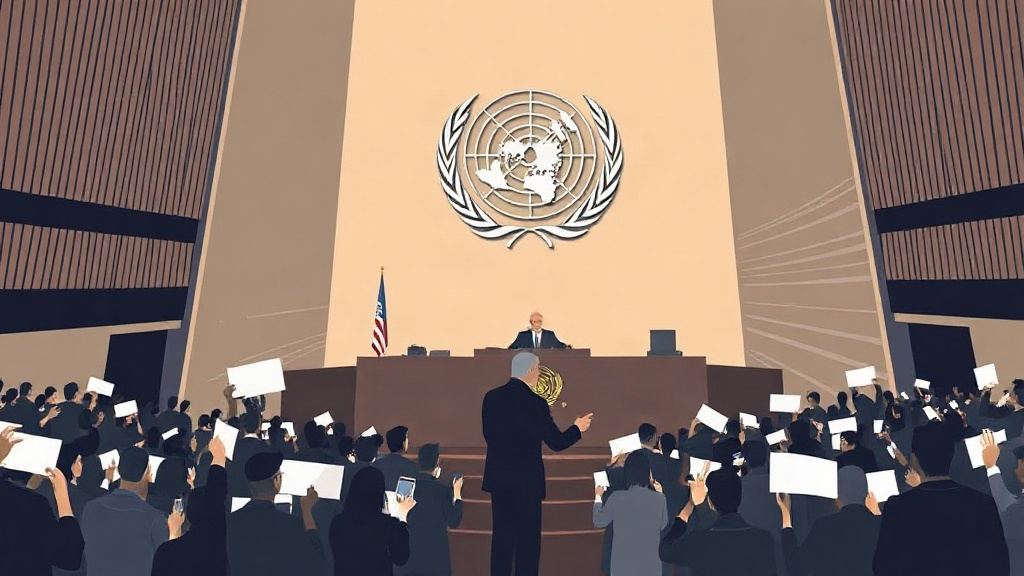
Netanyahu Draws a Hard Line
Israeli Prime Minister Benjamin Netanyahu formally rejected U.S. President Donald Trump's 15-point peace plan for Gaza on Sunday, declaring at a cabinet meeting that the Israeli military "will not carry out any withdrawal until Hamas is genuinely disarmed and will continue to thwart threats against our forces and our citizens." [1] The announcement delivers a significant blow to months of U.S.-led diplomacy and leaves the future of Gaza's ceasefire framework in serious doubt.
The rejection did not come entirely without warning, but its timing — just over a week after Trump hailed what he called a "monumental step toward lasting peace and security" — underscores the widening gap between Washington's ambitions and Jerusalem's conditions. [3]
What the 15-Point Plan Actually Proposes
On July 30, the U.S.-led Board of Peace — a body created by Trump in October, with Trump serving as its lifetime chair and designated by UN Security Council Resolution 2803 as the overseer of Gaza's peace process — released a phased, conditional roadmap for disarmament and reconstruction. [1]
The plan calls for Hamas and other armed groups to surrender their weapons to an independent Palestinian National Committee, supported by an international security force. In exchange, Israeli forces would withdraw in stages as disarmament is verified. Reconstruction of the war-shattered territory would follow. [1][3]
Trump announced late last month that Hamas had, for the first time, agreed in principle to disarm — on the condition that Israel simultaneously withdraws its forces. [3] Hamas subsequently reaffirmed that commitment, with a Hamas official telling the BBC on Sunday that the group was "ready to engage seriously and responsibly in implementing" the plan, while calling on mediators to ensure "all parties comply with what has been agreed." [3]
The sequencing, however, is precisely where the deal breaks down. Netanyahu insists disarmament must come first and be complete before any Israeli pullback. Hamas insists withdrawal must accompany disarmament. The Board of Peace, for its part, said this week that Israeli withdrawal would only occur after Hamas disarmament is verified — a position closer to Israel's, yet still insufficient to bring Netanyahu on board. [1]
Election Politics and the "Forever War"
Analysts are nearly unanimous that domestic Israeli politics are driving Netanyahu's calculus. He faces a national election on October 27 and, according to successive polls, is currently on course to lose. [1] His right-wing coalition partners have applied intense pressure: National Security Minister Itamar Ben Gvir dismissed the draft plan as "not acceptable" and called for a new cabinet vote to formally end the Gaza framework. [3]
Former Israeli diplomat Alon Pinkas offered a blunt assessment: Netanyahu needs "a forever war." Pinkas told Al Jazeera that the rejection "should be viewed entirely in the context of the upcoming Israeli election," arguing that Netanyahu calculated "this is risk free — that he can supposedly defy Trump because Trump doesn't care enough." [1] This represents Pinkas's analytical framing, not an established characterization of Israeli policy.
Israeli analyst Dan Perry pushed back on the strategic logic, telling Al Jazeera that Netanyahu's move is "misaligned with what the people in Israel would generally want, if they understood correctly what's going on." Perry added: "Even if there is an idea that there is a declarative agreement to disarm, it is something that should be welcomed so clearly." [1]
Palestinian Reaction: Uncertainty Deepens
For Gaza's civilians, the rejection translates into continued limbo. About 1.9 million people — roughly 90 percent of Gaza's population — have been displaced since the war began following Hamas's October 7, 2023 attack, in which approximately 1,200 Israelis were killed and 251 taken hostage. [3] More than 73,000 Palestinians have since been killed, according to Gaza's Health Ministry, figures the United Nations considers reliable. [3] Israel has continued carrying out strikes on Gaza even after agreeing to an initial ceasefire in October 2025, killing more than 1,200 Palestinians since that agreement. [1]
Al Jazeera's Hani Mahmoud, reporting from Gaza City, said residents "expected" the rejection but that it was "translating into greater uncertainty." He noted the plan had been intended to resolve critical sequencing questions — Israeli withdrawal from the so-called Yellow Line, Hamas disarmament, and the entry of international stabilization forces — and that its full rejection now leaves "no clear end to hostilities." [1]
Palestinian political analyst Xavier Abu Eid argued the framework was flawed from the outset, telling Al Jazeera that both Trump's original 20-point plan and the 15-point follow-on "were more about meeting Israeli interests than the Palestinian right to self-determination." He also noted that Trump "has never even pretended to push any sort of accountability measures for Netanyahu violating even their own agreements." [1]
Washington Pushes Back — Cautiously
Senior Board of Peace diplomat Nickolay Mladenov defended the plan on Sunday, telling Israel's Channel 12 that it remained "the only way forward" to prevent a repeat of October 7. He described the framework as "verifiable, reversible" and built "with a very clear-eyed understanding of what are the challenges ahead," stressing that Israel would not be required to withdraw until Hamas's disarmament steps could be independently confirmed. [3]
Netanyahu, for his part, indicated he was not entirely closing the door on negotiations, saying Washington and Jerusalem were in active discussions. "They have ideas; some of them are acceptable to us and some are not, and we know how to stand our ground on these matters," he said. [1][3]
What to Watch Next
The critical pressure points in the coming weeks will be whether Trump applies meaningful leverage on Netanyahu — something analysts say he has so far avoided — and whether the Board of Peace can bridge the sequencing dispute between Israel and Hamas before the October 27 Israeli election effectively freezes any diplomatic movement. Hamas's stated willingness to engage with the plan stands in contrast to Israel's outright rejection, shifting at least the rhetorical burden onto Jerusalem. How Washington responds to being publicly rebuffed by its closest Middle East ally will be the defining signal of whether Trump's Gaza framework has any remaining life.