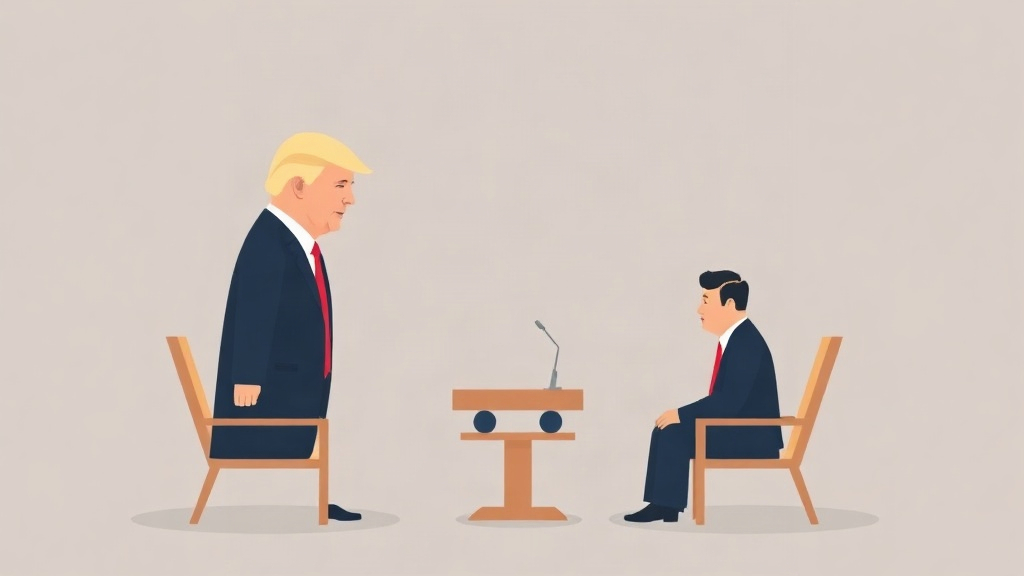
President Donald Trump is set to welcome Chinese President Xi Jinping to Washington this week in one of the most consequential diplomatic meetings of his second term — a multi-day summit spanning trade concessions, rare earth supply chains, and the intensifying global race over artificial intelligence [1].
An Unusual Welcome at Joint Base Andrews
The visit kicks off Wednesday with Trump personally greeting Xi at Joint Base Andrews — a departure from the standard protocol of receiving foreign leaders at the White House [1]. That symbolic gesture alone signals how much weight both sides are placing on the encounter. The schedule that follows is dense: a formal welcome ceremony, a state dinner on Thursday attended by several tech company CEOs, and a series of private, closed-door sessions [1].
Simultaneously, a parallel track of negotiations is unfolding in New York, where Treasury Secretary Scott Bessent and U.S. Trade Representative Jamieson Greer are sitting down with China's Vice Premier He Lifeng [1]. The two-city structure reflects the breadth of issues on the table and the number of agencies with a stake in the outcome.
Tariffs and the Nonstrategic Goods Opening
One of the more concrete possibilities to emerge ahead of the summit is a mutual easing of tariffs on certain nonstrategic goods [1]. Officials described this as a step that could benefit both economies, though they stopped well short of signaling any sweeping rollback of the broader tariff architecture that has defined U.S.-China trade relations in recent years.
Trump, speaking to reporters from the Oval Office on Friday, struck a tone that blended confidence with transactional candor. "We're going to have a lot of different deals. We're not just doing it for our health. We're going to have some pretty important meetings. You know, China is paying us a lot of tariffs," he said. "But we're doing very well with China and President Xi and I have a good relationship." [1]
The framing is consistent with Trump's long-standing approach: projecting leverage while keeping the door open to deal-making.
Rare Earths: Supply Access Without Security Concessions
Rare earth minerals are expected to occupy significant time in the closed-door sessions [1]. China controls a dominant share of global rare earth processing, and those materials are critical inputs for a wide range of U.S. defense and consumer technology — from F-35 fighter jets to smartphones [1].
Officials indicated that discussions will focus on China's flow of rare earths to the United States, but drew a firm line on reciprocal concessions: the U.S. is unlikely to ease its export controls on sensitive materials, citing national security concerns [1]. That asymmetry — seeking greater access to Chinese rare earths while maintaining restrictions on U.S. technology exports — is likely to be one of the more friction-laden elements of the talks.
AI at the Center: An "AI Force" and a New Czar
Artificial intelligence has emerged as perhaps the defining strategic theme of the summit, and Trump has been vocal about framing it in terms of national competition and economic transformation.
In a social media post ahead of the meetings, Trump announced plans to create an "AI Force" modeled on the U.S. Space Force, and said he intends to appoint a new AI czar [1]. His post left little ambiguity about his ambitions: "AI is the next Industrial Revolution, or Internet, but will be even larger and more impactful, possibly as much as 25% of our Country's GDP. We are leading China, and the rest of the World, and I intend to keep it that way!" [1]
The presence of tech company CEOs at Thursday's state dinner reinforces the extent to which the private sector is being woven into the diplomatic conversation [1]. Whether those executives will play a formal role in any AI-related agreements — or serve primarily as a show of American technological strength — remains unclear ahead of the meetings.
What the Summit Reveals About the Relationship
The structure of this visit — the tarmac greeting, the multi-day schedule, the parallel New York talks — points to a relationship that both sides are treating as too consequential to leave to lower-level channels. Trump has consistently described his personal rapport with Xi as a stabilizing factor, and the summit format appears designed to capitalize on that dynamic.
At the same time, the constraints are real. Export controls are staying in place. AI competition is being framed in zero-sum terms. And the tariff relief being floated is explicitly limited to nonstrategic goods — a category that, by definition, excludes the most contested economic terrain [1].
What to Watch
The most immediate signal to track will be whether Wednesday's opening session produces any joint statement or agreed framework on tariffs — even a narrow one — that can be announced before Xi departs. On the AI front, watch for any specifics around the proposed "AI Force" structure or the timeline for naming an AI czar, both of which Trump flagged as near-term announcements [1]. And on rare earths, any indication that China is willing to formalize or expand mineral supply commitments — without a reciprocal U.S. concession on export controls — would represent a significant diplomatic win for the Trump administration.