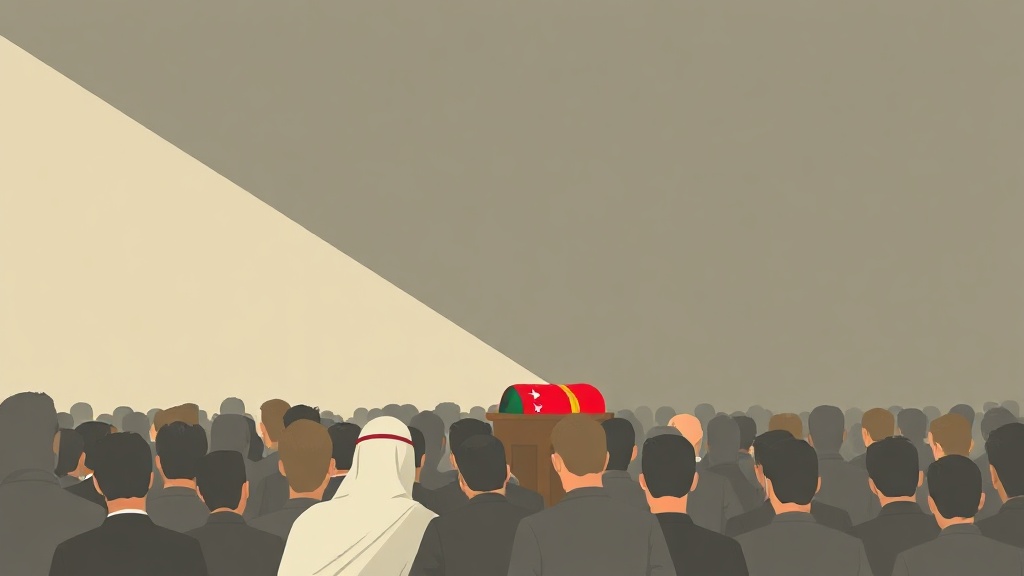
Thousands of Palestinians filled the streets of Gaza City on Tuesday for what is described as the largest mass funeral of its kind since the war began, as 112 members of two extended families — killed nearly three years ago — were finally laid to rest [1][2].
The victims, all from the Abu Sharia and Hassayna clans, died when a residential block in the Sabra neighbourhood was struck by Israel on 22 November 2023 — six weeks into the war that followed the Hamas-led assault on southern Israel on 7 October of that year, which killed approximately 1,200 people and resulted in 251 being taken hostage [1]. The building was flattened, and the scale of the destruction meant that recovery of the remains took until now [2].
Two Weeks of Excavation
Gaza's Civil Defence spent two weeks excavating the destroyed multi-storey building before recovering all 112 bodies [1][2]. The operation involved a single bulldozer clearing the bulk of the rubble, followed by painstaking work done by hand [1]. Civil Defence spokesman Mahmoud Basal had described the scale of the tragedy at the outset of the operation: "There were maybe more than 180 civilians inside. Most of them, around 90%, were killed." [1]
He also noted that crews were unable to reach the site immediately after the November 2023 strike because of safety concerns and the need to coordinate access with Israel through a third party [1].
Among those recovered were 44 children, 38 women, and seven people with disabilities [1]. Relatives of the dead were present throughout the excavation to help guide recovery teams [1]. It is believed that dozens more bodies remain at the site, and thousands more people are unaccounted for across the Gaza Strip, with many thought to be buried beneath rubble from Israeli airstrikes [1].
The Role of the ICRC
The International Committee of the Red Cross provided critical logistical and technical support throughout the recovery operation. Patrick Griffiths, a spokesperson for the ICRC, described the organisation's contribution: "We provide material support — literally the gloves, shovels, protective equipment and body bags they use. We provide training, supporting them to do their work safely, in line with professional practice ensuring the deceased are treated with dignity." [1]
The ICRC also rented two of the only excavators available in Gaza for hundreds of hours to assist the effort [1]. Griffiths acknowledged the painful nature of the process for families: "It's not an answer any family wants to receive — confirmation that your loved one has been killed. But it's essential towards them receiving closure and being able to mourn their loss in their own way." [1]
Grief and Survival
The funeral drew enormous crowds, with bodies wrapped in Palestinian flags carried through the streets before burial [2]. Some of the deceased had photographs placed alongside them as they were lined up in rows before relatives carried them away [1].
For those who survived, the ceremony carried an almost unbearable weight. "I'm the sole survivor of my family," said Yousef Abu Sharia. "Today, I'm talking to you [as] the one who lost my mother, my father, my uncle and my cousins and all my family. I lost them under this rubble." [1]
Nahed al-Hassayna walked the BBC through the rubble of his family's living room, holding up the belongings of two young relatives. "This was a school backpack for Omar, and this was Ibrahim's shoe," he said. "Why? Why were they killed?" [1]
Even amid the grief, some mourners described a measure of relief at finally being able to bury their dead. "After we managed to retrieve them and bury them, perhaps we can be partially relieved despite the pain of loss and all we're still living through," said mourner Ali Abu Sharia [1].
Calls for Accountability
Relatives used the occasion to renew accusations that Israel committed war crimes and called for international investigations into the November 2023 strike and the broader pattern of civilian deaths across the territory [2]. The BBC reported that it has asked the Israel Defense Forces for information on what was targeted in the Sabra strike but had not received a response at the time of publication [1].
The Hamas-run health ministry, whose figures the United Nations considers reliable, puts the total death toll in Gaza since the start of the war at at least 73,377 [1].
What to Watch
With dozens of bodies still believed to be buried at the Sabra site alone, and thousands more unaccounted for across Gaza, the question of how — and whether — further recovery operations can be conducted remains urgent [1]. International pressure for independent investigations into specific strikes, including the one that killed the Abu Sharia and Hassayna families, is likely to intensify following the funeral [2]. Whether the IDF responds to questions about the November 2023 Sabra strike will be a key indicator of how much transparency, if any, Israel is prepared to offer on individual incidents from the war's early weeks.

