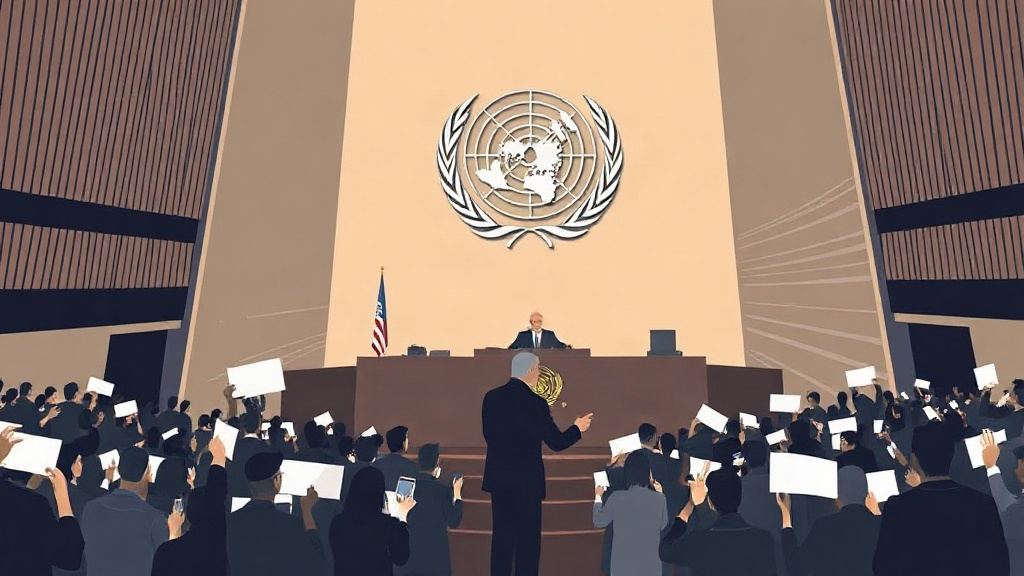
Guterres Makes Historic Damascus Visit, Demands Full Sanctions Lift
UN Secretary-General Antonio Guterres wrapped up a landmark two-day visit to Syria on Sunday with a pointed message to the international community: partial measures are not enough. Speaking at a press conference in Damascus, he called for the complete and immediate removal of all sanctions that were imposed on Syria during the rule of ousted president Bashar al-Assad [1].
"I welcome steps that have eased sanctions, and opening new possibilities for economic recovery, but all these sanctions must be removed immediately," Guterres told reporters [3]. The statement signals that, in his view, the incremental easing announced by Western nations — including the United States — falls short of what Syria's fragile recovery demands.
Guterres is the first UN chief to set foot in Syria since his predecessor Ban Ki-moon visited in 2009, two years before the outbreak of a civil war that ultimately killed more than half a million people [4].
A Country at a Crossroads
Syria's new leadership, which took power in December 2024 following Assad's overthrow, is attempting to rebuild a nation shattered by more than thirteen years of conflict [1]. The scale of the challenge is staggering: the World Bank has estimated that post-war reconstruction could cost as much as $216 billion, a figure that has kept private investors cautious despite the partial sanctions relief already granted [3].
Guterres framed his visit in explicitly urgent terms. "The United Nations stands with the people of Syria at this pivotal moment. And I came carrying the strongest possible appeal to the international community, an appeal to spare no effort to support the Syrian people and to support the Syrian government," he said [1]. He added that "Syria today is at a crossroads," underscoring that the window for decisive international action may be narrow [4].
The humanitarian dimension is equally daunting. According to UN figures, approximately 1.7 million refugees have returned to Syria since Assad's fall — a meaningful sign of cautious optimism — but around 5.5 million people remain internally displaced and a further six million are still living abroad [3].
Who Guterres Met — and Where
During the visit, the UN chief held meetings with President Ahmed al-Sharaa, Foreign Minister Asaad al-Shaibani, and the speaker of Syria's new transitional parliament, which convened its first session only this month [4]. He also met with members of the UN peacekeeping force stationed in the Israeli-occupied Syrian Golan Heights, and engaged with representatives of civil society, women's groups, and youth organisations [3].
One of the most symbolically charged stops was Sednaya prison on the outskirts of Damascus — the facility that became synonymous with the Assad regime's systematic brutality [4]. The visit served as a tacit acknowledgment of the atrocities that underpinned international pressure on the former government, and implicitly reinforced the argument that the sanctions regime was designed for a government that no longer exists.
Transition Endorsed — With Caveats
Guterres offered a measured but notable endorsement of Syria's political direction. "I have no doubt to say this transition is going in the right direction," he said [3]. Since Sharaa assumed power, the international community has pressed the new Islamist-rooted authorities to build a governance model that genuinely reflects Syria's multi-ethnic and multi-confessional makeup [4]. Guterres's positive assessment comes with that expectation still very much in play.
At the same time, he did not shy away from a separate and escalating tension. Hours before his press conference, Syrian state media reported that Israeli forces had conducted an incursion and artillery shelling in southern Syria [3]. Guterres reiterated that "violations of Syria's sovereignty and territorial integrity are unacceptable" [4]. Since Assad's fall, Israel has moved troops into the UN-patrolled buffer zone on the Golan that had been in place since 1974, and has carried out repeated strikes and incursions deeper into Syrian territory as it seeks to establish a broader demilitarised zone [3].
What Syria Says It Needs
Beyond sanctions relief, Guterres outlined a broader package of international support that Syria requires. "Syria needs investment in its people, its economy and its institutions. Syria needs support to restore essential services, rebuild infrastructure, revive livelihoods," he said [1]. He also stressed the importance of enabling "the safe, voluntary and dignified return of refugees and internally displaced people" — a process that has begun but remains far from complete [3].
The UN's position is clear: symbolic gestures and phased rollbacks are insufficient when set against a $216 billion reconstruction bill and millions of displaced citizens [4]. Whether the international community — and particularly Western governments that designed and maintained the sanctions architecture — will move at the pace Guterres is demanding remains the central open question.
What to Watch Next
The immediate pressure points are several. Watch for whether the United States and European Union move to formally and fully rescind remaining Syria sanctions, or continue a piecemeal approach. Monitor how quickly private investment follows any further sanctions relief, given persistent investor caution. Track the trajectory of Israeli military activity in southern Syria, which Guterres's comments suggest could complicate diplomatic momentum. And observe whether Syria's transitional government advances the inclusive governance reforms the international community has made a condition of deeper engagement.