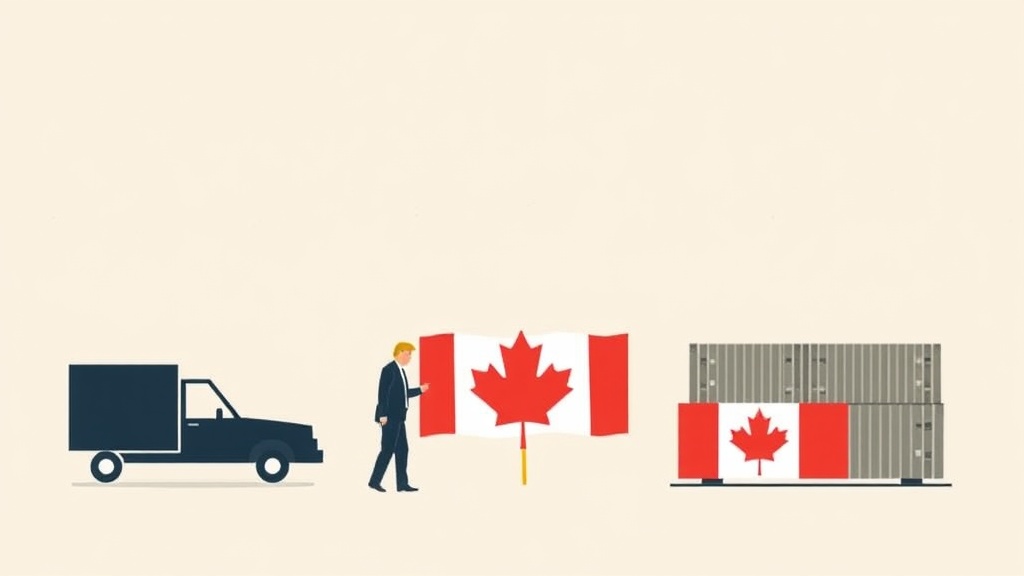
Trump Escalates Trade War With Canada, Announcing 50% Tariffs
The United States has dramatically escalated its trade conflict with Canada, with President Donald Trump signing three executive proclamations on Monday imposing 50% tariffs on a broad range of Canadian imports. [1] The duties, set to take effect within 30 days, represent the most sweeping unilateral trade action Washington has taken against its northern neighbor and mark a significant breakdown in ongoing negotiations between the two countries. [2]
What's Targeted — and What's Spared
The new tariffs cast a wide net, covering everyday consumer goods such as wine and hockey sticks as well as industrial products including commercial cement. [1] Crucially, the measures apply to all covered goods regardless of whether they were previously protected under the United States-Mexico-Canada Agreement (USMCA), the trilateral free trade pact that was itself a Trump-era renegotiation of NAFTA. [1]
Several categories are explicitly excluded. Energy products, fish, critical minerals, and potash will not face the new duties. [2] Goods already subject to separate national-security tariffs — such as steel and aluminum — are also carved out. [1]
The Legal Mechanism: Section 338
Notably, the White House chose a different legal vehicle than it has used in previous tariff actions. Trump signed the proclamations under Section 338 of the 1930 Tariff Act, a provision that addresses trade discrimination rather than national emergencies. [1] This is a direct consequence of a landmark February ruling in which the U.S. Supreme Court, in a 6-3 decision, struck down Trump's earlier sweeping global tariffs, finding he had exceeded his authority by invoking the International Emergency Economic Powers Act of 1977 — a law reserved for genuine national emergencies. [2] The administration had vowed at the time to find alternative legal mechanisms to impose import taxes. [1] As a further consequence of that ruling, the U.S. has been required to pay back $81 billion in tariffs collected so far this fiscal year. [2]
Several Democratic lawmakers had previously proposed repealing Section 338, warning that Trump could use it to destabilize the economy. [2]
The Stated Grievances: Cars, Dairy, and Alcohol
The White House fact sheet frames the tariffs as holding Canada "accountable for its continued discrimination against and unreasonable and unequal treatment of U.S. commerce." [2] Three specific irritants are cited in the proclamations.
On automobiles, Trump argues that Canada charges a tax on U.S. motor vehicles and parts not covered under USMCA, and that this treatment is discriminatory because Canada does not impose similar charges on other countries. [1] The proclamations note that Canada has maintained a 25% retaliatory tariff on U.S. motor vehicle imports — tariffs that were themselves a response to earlier U.S. duties — since April 2025. [2] Automotive manufacturing across North America is deeply integrated between the three USMCA partners, complicating any clean separation of trade flows. [1]
On dairy, the long-standing friction centers on Canada's supply management system, which caps foreign imports and levies tariffs exceeding 300% on volumes above those limits. [1] Trump's proclamation also claims Canada discriminates against U.S. cheese relative to European dairy products. [2]
On alcohol, all but two Canadian provinces and territories halted the sale of U.S. alcoholic beverages — a boycott imposed in response to earlier American tariffs. [2] Canadian premiers have repeatedly stated the boycott will be lifted if the U.S. removes tariffs on key Canadian sectors, including metals and automobiles. [1]
Canada's Response: Defiance and an Open Door
Canadian Prime Minister Mark Carney said his government had made "comprehensive proposals to resolve trade disputes with Washington," asserting that Trump's past tariffs had themselves violated the USMCA. [2] "This trade dispute has raised costs for families, particularly in the US," Carney said. "Canada stands ready to engage intensively to address outstanding issues with the US to the mutual benefit of our citizens." [2]
Ontario Premier Doug Ford took a harder line, posting on social media that Canada should respond "tariff for tariff, dollar for dollar" if the new duties proceed. [2]
Candace Laing, CEO of the Canadian Chamber of Commerce, called the move "regrettable" but urged both governments to use the 30-day window before the tariffs take effect "to make meaningful progress in advancing formal talks." [2]
The Wildfire Thread — and What the Orders Don't Say
The announcement comes days after Trump threatened Canada with tariffs over wildfire smoke drifting into U.S. cities, writing on Truth Social that the U.S. was being "invaded by filthy, polluted, and unhealthy air." [2] Trump reportedly raised the issue directly with Carney during a meeting on Sunday, telling reporters: "I told him, I mean, 'You got to stop these fires from coming in and, you know, poisoning our air.'" [2]
Yet the three proclamations Trump signed on Monday contain no mention of wildfires. [1] Instead, they focus exclusively on the pre-existing trade irritants over cars, dairy, and alcohol — suggesting the wildfire rhetoric served as political pressure rather than a formal legal basis for the tariffs. A White House official separately told reporters that Trump has asked aides to explore additional tariffs related to Canadian wildfire smoke, indicating that front may not be closed. [2]
A Broader Economic Context
The new duties layer onto an already fraught tariff landscape. The U.S. currently maintains tariffs ranging from 15% to 50% on Canadian steel, aluminum, and copper, as well as a 35% tariff on Canadian softwood lumber and a 25% tax on non-U.S. parts in automobiles. [1] Canada, in turn, has its own 25% counter-tariffs on selected American steel, aluminum, and vehicles. [1]
Economists and analysts warn the 50% tariffs risk reigniting the inflationary pressures and market turbulence that followed Trump's "liberation day" tariffs in April 2025, which triggered a financial market meltdown and were temporarily walked back. [2] The risks are particularly acute given that the two economies remain deeply intertwined despite the trade hostilities of the past year.
What to Watch
The 30-day window before the tariffs take effect is the immediate pressure point. Canadian trade negotiators have been working toward a deal that would reduce existing U.S. tariffs, and Carney's government has signaled it wants to negotiate rather than simply retaliate. [1] Whether the two sides can reach even a partial agreement — or whether Canada follows Ford's call for dollar-for-dollar retaliation — will set the tone for North American trade relations heading into the U.S. midterm elections in November, where the economic fallout from tariff policy is expected to be a central issue. [2]
