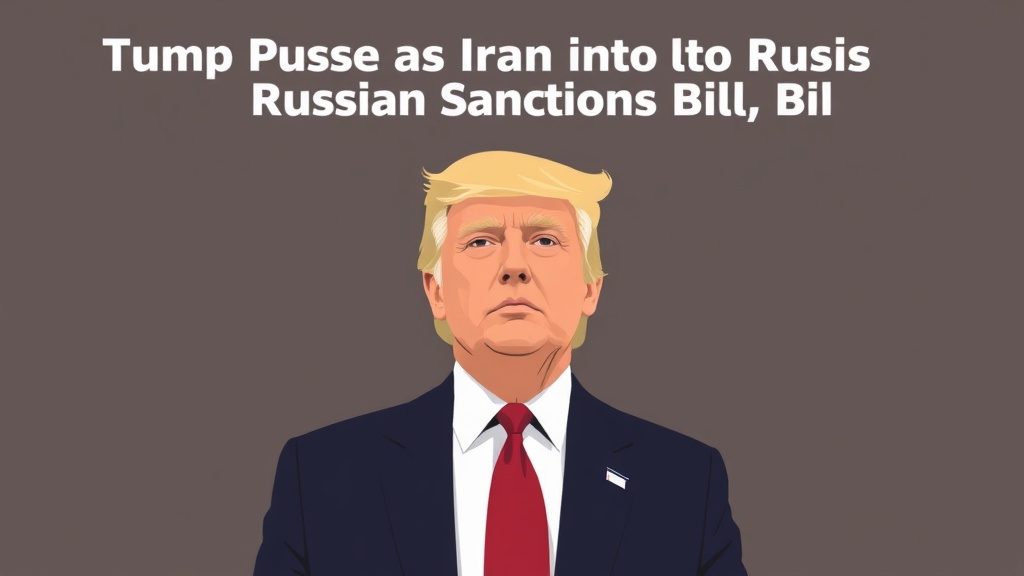
Trump Calls for Iran's Inclusion in Russia Sanctions Legislation
Hours after the United States carried out its eighth consecutive night of major strikes by U.S. Central Command forces against Iran, President Donald Trump on Sunday turned to economic pressure, urging Republican lawmakers to fold Tehran into a sweeping Russia sanctions bill already moving through the Senate [4].
"Republicans should add Iran to the Russian Sanctions Bill. That's what Lindsey wanted to do, and it was going to happen. Important!!!" Trump wrote in a post on Truth Social [1].
The call came just days after a bipartisan group of more than 60 senators introduced revised legislation formally titled the "Senator Lindsey O. Graham Sanctioning Russia Act of 2026," named in honor of the late senator who championed the measure before his death [1].
The Graham Bill: What It Does
The legislation, introduced by Senators Jeanne Shaheen, Richard Blumenthal, and Darline Graham, is designed to hold the world's largest buyers of Russian energy accountable for financing Moscow's war in Ukraine [1]. Graham and Blumenthal had first introduced the sanctions proposal in April 2025, and Graham reportedly met with Ukrainian President Volodymyr Zelenskyy last week, securing White House agreement on the revised text before his death [3].
The revised bill represents a significant refinement from its earlier form. Rather than imposing a blanket 500 percent tariff, it narrows the penalty to targeted tariffs of up to 100 percent on the top five purchasers of Russian crude oil and natural gas [1]. Countries importing less than 15 percent of Russia's natural gas exports that are actively working to reduce those imports would be exempted [3].
The updated legislation also adds new authority to impose tariffs of up to 100 percent on the top five countries facilitating Russian oil sanctions evasion, incorporates the bipartisan SHADOW Fleet Sanctions Act targeting Russia's sanctions-evasion fleet, and includes the bipartisan STOP Russia-China Act targeting Chinese support for Russia's defense industrial base [1]. Any waiver granted by the president would require a national interest certification consistent with other sanctions laws [4].
Trump had previously endorsed the bill in January, backing measures targeting countries that purchase Russian oil [3].
Iran's Shadow Over the Bill
Trump's push to add Iran comes against a backdrop of escalating military confrontation. The Truth Social post was published hours after U.S. Central Command conducted strikes against Iran for the eighth straight night [4]. Trump had separately said he "couldn't care less" about Iran's decision to stop abiding by the U.S.-Iran memorandum of understanding, while reiterating that Washington's core priority remains preventing Tehran from acquiring a nuclear weapon [1].
Folding Iran into the bill would layer additional economic pressure onto sanctions already described as crippling against Tehran [4]. The most significant downstream effect, however, could fall on China. Beijing is both the largest buyer of Iranian oil and Russia's biggest trading partner, meaning it could potentially face a compounded tariff hit — one for purchasing Russian energy and another for purchasing Iranian oil — if the bill is expanded as Trump envisions [4].
India, one of the other largest buyers of Russian oil, would also be in the crosshairs of the legislation's tariff authority [4].
The China and India Complication
The prospect of hitting China and India simultaneously with steep tariffs introduces considerable political and economic complexity. With oil prices already set to rise because of the renewed conflict with Iran, Trump could face pressure to use the bill's waiver authority rather than trigger tariffs against two of the world's largest economies [4]. The national interest certification requirement built into the revised bill means any such waiver would need to be formally justified — a provision designed to limit the president's flexibility to quietly exempt major trading partners [4].
That tension — between maximizing economic leverage over adversaries and managing the collateral impact on large trading partners — is likely to shape the congressional debate over whether and how to incorporate Iran into the legislation.
What Lindsey Graham Wanted
Trump's invocation of Graham's name carries both political and legislative weight. Graham was a central architect of the Russia sanctions effort, and the bill was renamed in his honor after his death [1]. By framing the Iran expansion as fulfilling Graham's wishes, Trump is appealing to Republican colleagues who respected the late senator while also signaling that the White House views the two pressure campaigns — against Russia and Iran — as complementary rather than separate tracks.
The bill's sponsors have not yet publicly responded to Trump's call for expanding the legislation to include Iran.
What to Watch
The immediate question is whether the bill's Senate sponsors will agree to incorporate Iran-focused provisions, and whether doing so risks fracturing the bipartisan coalition of more than 60 senators that backed the Russia-focused version [1]. Separately, the White House's posture on waivers — particularly for China and India — will be a key indicator of how aggressively the administration intends to enforce any expanded legislation. With U.S. military operations against Iran ongoing and nuclear negotiations in the background, the fate of this bill has become one of the clearest legislative tests of how Washington intends to coordinate its military and economic pressure on Tehran.