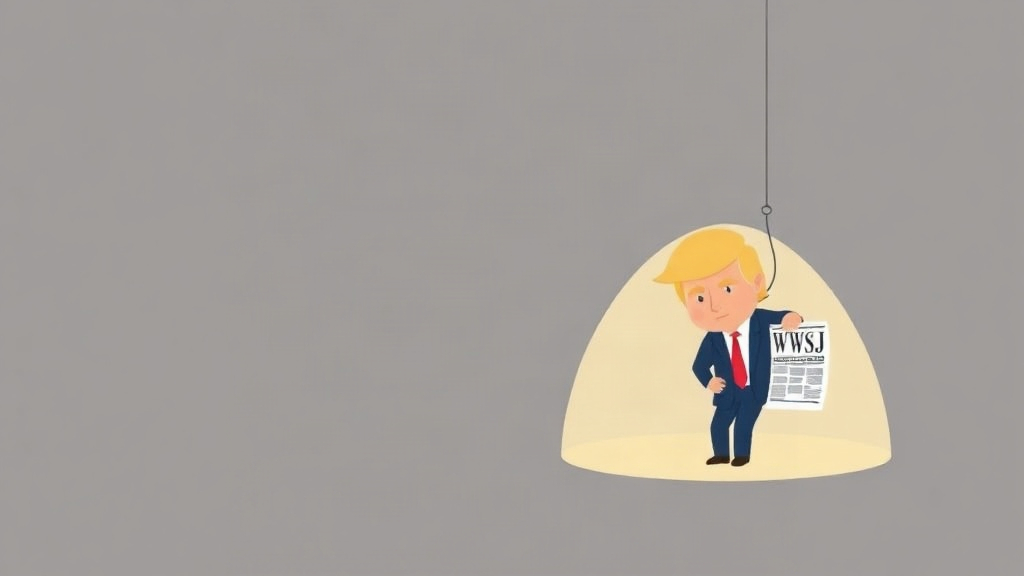
A federal judge has permanently ended President Donald Trump's defamation lawsuit against The Wall Street Journal, ruling Saturday that the case failed to meet the legal threshold required to hold a news organization liable for defamation — and closing the door on any future attempt to revive it. [1]
U.S. District Judge Darrin P. Gayles, sitting in Miami, dismissed the suit with prejudice, meaning Trump cannot refile the claim. The ruling delivers a decisive legal defeat to a president who has made confrontation with the press a central feature of his second term. [2]
What the Lawsuit Was About
The case stemmed from a 2025 Wall Street Journal investigation describing a sexually suggestive letter and drawing that the paper reported bore Trump's name and was included in a birthday album assembled for convicted sex offender Jeffrey Epstein's 50th birthday in 2003. [2] The album was reportedly compiled by disgraced British socialite Ghislaine Maxwell. [2] According to the Journal's reporting, the letter — framed by the outline of what appears to be a hand-drawn naked woman — ends with the line, "Happy Birthday — and may every day be another wonderful secret." [2]
Trump denied writing the letter and called the story "false, malicious, and defamatory." [2] He filed suit in federal court in Miami in July 2025, targeting the Journal, its parent companies Dow Jones & Co. and News Corp, the reporters who wrote the story, and media mogul Rupert Murdoch. [1] On Truth Social at the time, Trump declared: "We have just filed a POWERHOUSE Lawsuit against everyone involved in publishing the false, malicious, defamatory, FAKE NEWS 'article' in the useless 'rag' that is, The Wall Street Journal." [1]
The Legal Standard Trump Couldn't Clear
The central issue in the case was the legal doctrine of "actual malice," established by the Supreme Court's landmark 1964 ruling in New York Times Co. v. Sullivan. [2] That precedent requires public figures seeking to win a defamation claim to demonstrate that a media outlet knowingly published false information or acted with reckless disregard for the truth — a deliberately high bar designed to protect press freedom. [2]
Judge Gayles ruled that Trump's lawsuit fell well short of that standard. In his opinion, he wrote that "the allegations regarding malice are conclusory, vague, sometimes inconsistent with the Article, and often irrelevant to whether Defendants knew or should have known that the statements in the Article were purportedly false." [1] The judge also noted that the Journal had not suppressed Trump's denial — rather, the paper "informed readers that President Trump decried the Letter as a fake and denied writing it." [2]
The ruling further stated that the lawsuit had attempted to "manufacture" flaws in the Journal's investigative reporting, with Gayles characterizing the president's legal arguments as "grasping at straws." [2]
A Second Swing, a Final Miss
This was not the first time Judge Gayles had rejected the lawsuit. In April, he dismissed the original complaint without prejudice, finding that it "fails to adequately allege actual malice" but granting Trump a single opportunity to amend and refile. [1] Trump's legal team submitted an amended complaint in May. [2]
Saturday's ruling made clear that the amended version did not remedy the deficiencies. By dismissing the case with prejudice this time, Gayles foreclosed any further attempts to pursue the same claims. [1] The damages Trump had sought were substantial — the initial filing demanded at least $20 billion across two counts of defamation, though the Hollywood Reporter characterized the suit as a $10 billion action. [1][2]
A Broader Pattern of Press Battles
The dismissal lands amid an unusually combative media landscape surrounding the Trump administration. Beyond the Journal case, Trump is currently embroiled in legal disputes involving the BBC and The Associated Press. [2] Most recently, CNN, MSNBC, and Politico filed suit against the administration after being barred from White House access in mid-September. [2]
Trump has routinely denounced outlets that publish coverage he objects to, frequently labeling them "fake news" and publicly attacking their journalists. [2] The failed Journal lawsuit fits that broader pattern — a high-profile legal threat that, in this instance, was tested in court and found wanting under established First Amendment doctrine.
Jeffrey Epstein, the central figure in the Journal's original story, died by suicide in a New York jail cell in August 2019 while awaiting trial on federal sex trafficking charges. [2] He and Trump had a falling-out years before Epstein's first arrest in 2006. [2]
What to Watch Next
With the Journal lawsuit now permanently closed, attention will turn to Trump's remaining press-related legal battles — particularly the access disputes with CNN, MSNBC, and Politico, which raise distinct First Amendment questions about government control over press credentials. Whether Saturday's ruling emboldens other news organizations currently facing legal pressure from the administration remains to be seen.