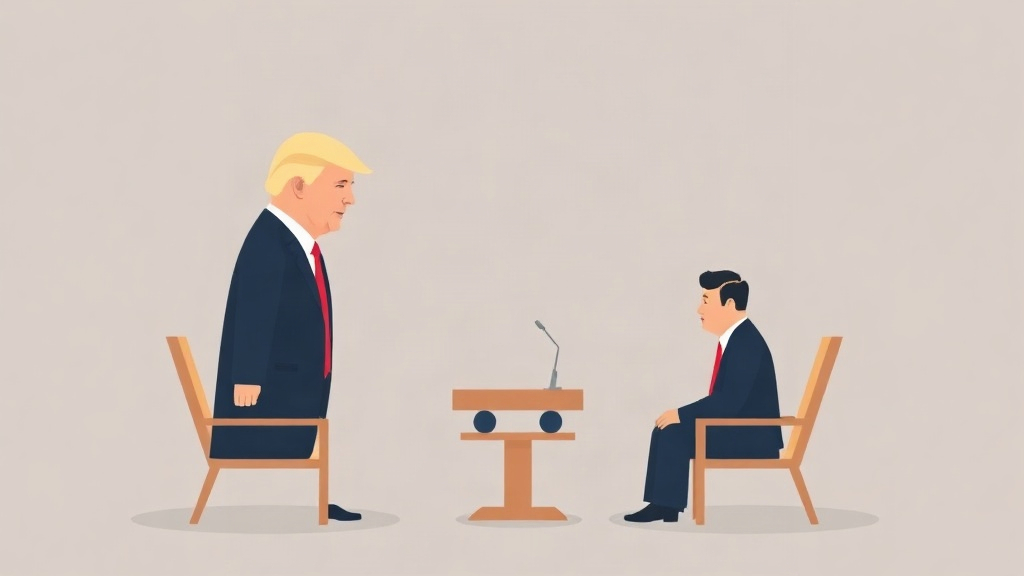
Chinese President Xi Jinping arrived in the United States on Wednesday for a high-stakes three-day state visit, greeted by President Donald Trump in a conspicuously rare gesture: a personal welcome on the tarmac at Joint Base Andrews in Maryland, well outside the customary protocol of receiving foreign leaders at the White House [1].
The arrival ceremony was elaborate by any measure. A 100-foot red carpet flanked by U.S. service members was rolled out on the runway, two B-1 bombers conducted a military flyover, and the flags and national anthems of both countries were presented [3]. Trump and First Lady Melania Trump shook hands with Xi and his wife, Peng Liyuan, before the two presidents walked side by side past a formation of U.S. soldiers and stood for a gunfire salute [1].
A Deliberate Show of Respect
The decision to travel to a military base rather than wait at the White House was widely read as a calculated diplomatic signal. Melania Trump framed it in straightforward terms, telling Fox & Friends on Wednesday morning: "He's coming on our soil, and we need to welcome them with the most respect" [3].
Trump is believed to be the first U.S. president in recent memory to personally meet a foreign leader at the airport [1]. The gesture underscores how seriously Washington views its relationship with Beijing — a relationship defined as much by rivalry as by interdependence, and one that has grown only more consequential as China's economic and military power has expanded over recent decades [1].
One moment briefly punctured the ceremony's solemnity: Trump visibly flinched when one of the military jets roared overhead during the national anthem, while Xi, Peng Liyuan, and Melania Trump remained visibly unmoved. The moment was captured on a White House livestream but was notably absent from the edited highlights later released by Trump's aides [3].
Trade Truce Gets a Lifeline
Alongside the pageantry came a concrete policy development. Treasury Secretary Scott Bessent announced Wednesday that the United States and China had agreed to extend the so-called "Busan agreement" — a temporary tariff truce between the world's two largest economies — until January 10, two months beyond its original November 10 expiration date [3]. Bessent made the announcement after meeting with Chinese Vice Premier He Lifeng earlier in the day [3].
The extension offers a measure of breathing room for both sides, though it resolves nothing structurally. The Trump administration's imposition of sweeping tariffs on Chinese goods earlier in his term had triggered retaliatory measures from Beijing, rattling global markets and supply chains [1]. Despite that friction, Trump has consistently expressed personal warmth toward Xi and spoken of wanting robust ties between the two countries [1].
A Packed Agenda: Tech, Taiwan, and More
The visit's schedule reflects the breadth and complexity of the U.S.-China relationship. Xi's itinerary includes a formal state welcome on the South Lawn of the White House, a private tea with the president and first lady, a military ceremony, and a tour of the National Archives — home to founding documents including the U.S. Constitution and the Declaration of Independence [1][3].
On Thursday, the White House is hosting a state dinner for Xi that will bring together some of the most powerful figures in American technology. Executives from OpenAI, Apple, xAI, Microsoft, Nvidia, Meta, and other firms have been invited [3]. The guest list reflects the centrality of artificial intelligence to the broader U.S.-China competition.
Trump has been emphatic on the subject. "There is a SICK conspiracy going on against AI and Data Centers, and the only one that is happy about it is China. WHOEVER WINS AI, WINS! We are leading China, and all others, and will continue to do so," he wrote on Truth Social last week [3]. Administration officials have argued that AI leadership is inseparable from military and economic dominance — a framing that elevates the technology race from a commercial contest into a matter of national security [3].
Beyond trade and technology, the two leaders are expected to discuss rare-earth minerals, U.S. policy toward Iran, and the perennially sensitive question of Taiwan — the self-governing island that Beijing claims as its own territory and that Washington has long maintained unofficial ties with [1]. Geopolitical instability more broadly is also on the agenda [3].
Reciprocity and Rivalry
Xi's visit is partly a reciprocation of Trump's own trip to China earlier this year, and the ceremonial scale of Wednesday's welcome reflects that dynamic [3]. Yet beneath the pageantry, the structural tensions between the two powers remain unresolved. Both governments continue to compete aggressively for political and economic influence across Asia, Africa, and beyond [1].
The Busan agreement's extension to January 10 means the next major decision point on tariffs will arrive just days after the new year — giving negotiators a narrow window to either reach a more durable framework or brace for renewed escalation.
What to Watch
The coming days will reveal whether the warmth of Wednesday's tarmac welcome translates into substantive progress on any of the thorniest issues dividing Washington and Beijing. Watch for signals from the state dinner on how U.S. tech executives navigate the tension between their business interests in China and Washington's push to restrict Beijing's access to advanced semiconductors and AI systems. The fate of the trade truce beyond January 10 — and whether the two sides can move toward a longer-term agreement — will be the clearest measure of whether this visit amounted to more than elaborate ceremony.