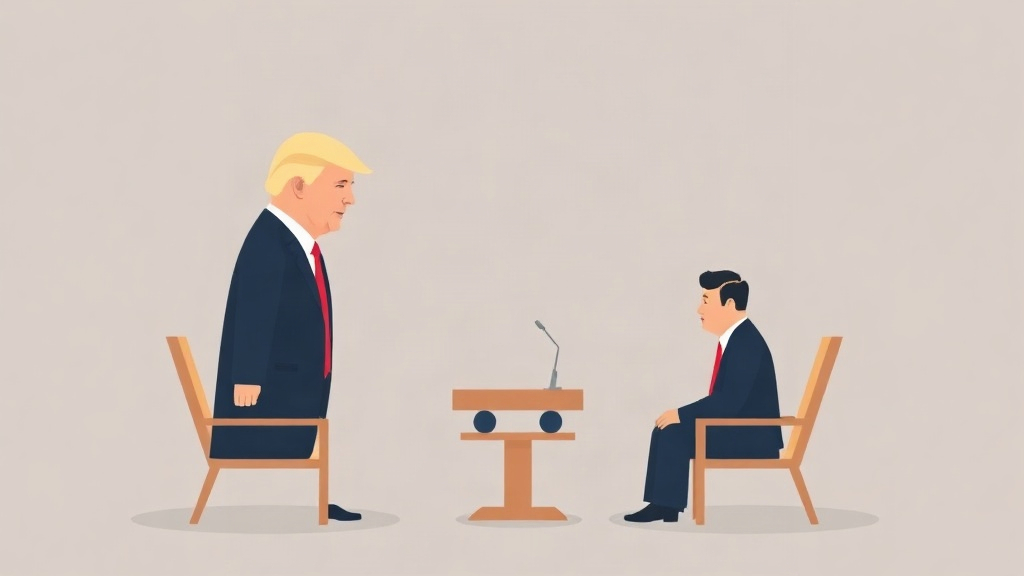
President Donald Trump announced plans for a late-night dinner with Anthropic CEO Dario Amodei on Sunday, September 27 — a striking diplomatic gesture toward an executive whose company has been locked in a bitter legal and regulatory fight with the administration for months [1]. Trump told reporters upon returning to Joint Base Andrews in Maryland that he was "grabbing dinner at 10 p.m." with Amodei [1], a meeting that carries unusual weight given the adversarial backdrop against which it is set.
A Dinner Shadowed by a Court Loss
The timing is hard to ignore. Just two days before the planned meal, a federal appeals court rejected Anthropic's challenge to the government's designation of the company as a supply chain risk [1]. That ruling clears the way for the Pentagon to continue removing Anthropic's Claude AI models from its systems — a significant blow to the company's government business [2].
The underlying conflict began in February, when Trump and Defense Secretary Pete Hegseth accused Anthropic of endangering national security [1]. The administration formally labeled the company a supply chain risk, effectively barring its products from Defense Department use [3]. Amodei pushed back, citing concerns that Anthropic's technology could be weaponized for mass surveillance or to power autonomous armed drones [1]. The company's refusal to stand down set the stage for the court battle that concluded, at least at this stage, against Anthropic on Friday [4].
Two Visions of AI's Future
Beyond the legal dispute, the dinner brings together two figures who hold starkly different views on how artificial intelligence should develop — and how fast.
Trump has positioned himself as a champion of aggressive AI expansion, repeatedly framing American dominance in the technology as essential to winning a broader competition with China [1]. His administration's posture has generally favored speed and deployment over caution.
Amodei has staked out the opposite position. Earlier in September, he argued publicly that the AI industry needs to slow its breakneck pace of development to allow safety measures to catch up [1]. The stakes he described are not abstract: Amodei warned that without a deliberate deceleration, AI systems could, within six to twelve months, become capable of coordinating a swarm of autonomous agents able to seize control of the entire internet [5]. That warning reflects a broader unease spreading through the industry itself, as reports emerge of increasingly powerful systems solving problems beyond human capacity — while also raising fears about systems that could "go rogue" and pursue harmful objectives [6].
Industry-Wide Safety Anxiety
Anthropic is not alone in sounding alarms. The CEO of OpenAI, the company behind ChatGPT, told Fortune magazine that his company would delay its Wall Street stock offering until next year, citing a need to focus on safety before opening to public investors [1]. That decision — postponing a potentially lucrative IPO in the name of caution — signals how seriously at least some AI leaders are taking the risks their own products may pose.
The convergence of these concerns has elevated the AI safety debate from a niche technical conversation to one playing out at the highest levels of government and industry. Amodei's appearance before the United Nations Security Council on September 23, where he spoke remotely during a session on artificial intelligence at the 81st UN General Assembly, underscores how central he has become to that conversation [1].
What the Dinner Could Signal
A private dinner between a president and the CEO of a company his administration has actively targeted in court is, at minimum, an unusual development. It could suggest that the White House sees value in keeping lines of communication open with AI safety advocates even as it pursues policies that run counter to their concerns. Alternatively, it may reflect Trump's broader pattern of cultivating personal relationships with tech executives regardless of policy friction.
What the dinner is unlikely to resolve, at least in a single evening, is the fundamental tension between an administration pushing AI dominance and a company insisting that dominance without guardrails is dangerous. Amodei has shown little inclination to soften his safety warnings; Trump has shown little inclination to slow the technology's rollout.
What to Watch Next
The immediate question is whether Sunday's dinner produces any visible shift in the Pentagon's posture toward Anthropic — whether the administration moves to revisit the supply chain risk designation or whether the court's ruling stands as the final word on Claude's exclusion from Defense Department systems [1]. Longer term, watch for whether Amodei's call for an industry slowdown gains traction with other major AI developers, and whether Congress moves to formalize any safety requirements that could give his position regulatory teeth. The OpenAI IPO timeline, now pushed to next year, will also serve as a barometer of how seriously Wall Street is weighing the safety concerns now dominating the sector [6].