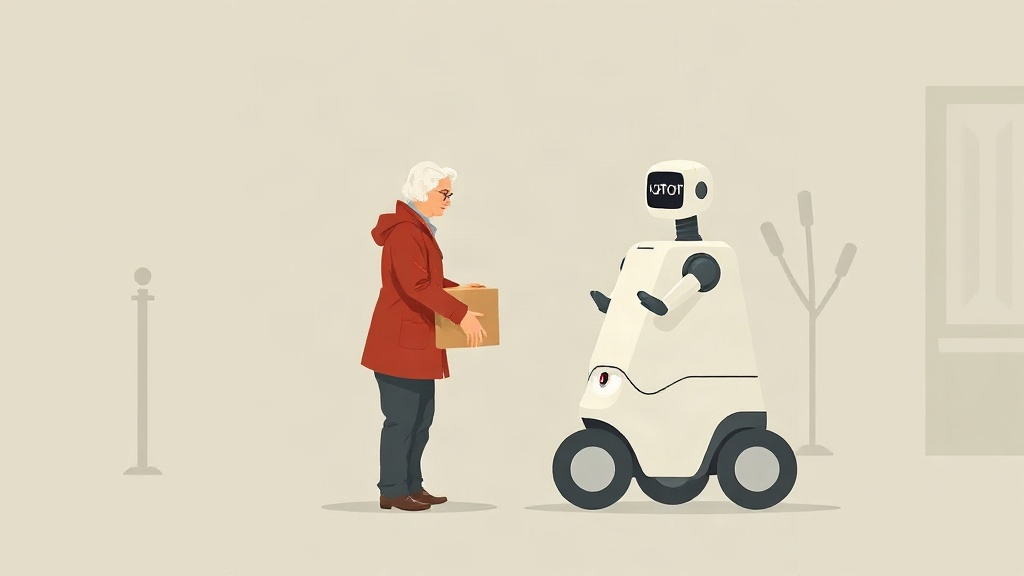
Retired Professor Plants Herself in Front of a Robot — and Gets Arrested
A 78-year-old retired academic is now at the center of a debate over who — or what — has the right to Philadelphia's sidewalks, after she was arrested for deliberately blocking an autonomous delivery robot and refusing to move.
Carolyn Marvin, a former communications professor at the University of Pennsylvania, was issued a criminal violation notice for disorderly conduct on October 14 following an encounter near the Reading Terminal Market in Center City [1]. The incident has drawn national attention, putting a human face on growing tensions between autonomous commercial technology and the workers and pedestrians who share the streets with it.
What Happened on Filbert Street
Philadelphia police responded to the 1200 block of Filbert Street at approximately 1:16 p.m. after receiving a report of "criminal mischief" involving a delivery robot [1]. According to a Philadelphia Police Department news release, officers "encountered a female who was refusing to allow a delivery robot to pass" and issued "multiple commands directing the female to move," which she declined to follow [2].
Marvin was not accused of damaging the robot or threatening anyone. The charge — disorderly conduct — stemmed entirely from her refusal to clear a path for the machine [1].
"I Wasn't Impeding Any Persons. I Was Impeding a Machine."
Marvin, speaking to CNN, was direct about both her actions and her reasoning. "I was under the impression that I had more rights than the robot did," she said. "I wasn't impeding any persons. I was impeding a machine." [1]
That framing — a human asserting precedence over an automated device on a public sidewalk — cuts to the heart of a legal and philosophical question that cities across the country have yet to fully resolve. As autonomous delivery robots become more common fixtures on urban streets, the rules governing their use of shared public infrastructure remain unsettled.
Marvin said her protest was aimed at three distinct concerns: the displacement of low-wage human workers by robotic systems, the safety implications of robots navigating crowded pedestrian spaces, and the surveillance potential of the cameras these machines carry [2].
"I also think that I have a First Amendment right to protest the abuses of corporations in public space, in the same public space that the robots are occupying," she told CNN [1].
The Broader Stakes: Jobs, Safety, and Surveillance
Marvin's protest, however brief and singular, surfaces a cluster of concerns that labor advocates, civil libertarians, and urban planners have raised with increasing urgency as delivery robots proliferate in American cities.
On the labor front, the robots she was blocking are designed to perform tasks — food delivery, package transport — that have historically been done by low-wage human couriers [1]. Critics argue that the economic benefits of automation flow primarily to the companies deploying the technology, while the costs are borne by workers who lose income and by communities that lose jobs.
The sidewalk safety argument is more immediate and tangible. Autonomous robots, however sophisticated their sensors, must navigate the same unpredictable environments as pedestrians: uneven pavement, crowds, cyclists, children, and people with mobility challenges. Whether current technology handles those conditions reliably enough to justify widespread deployment is a question that has not been definitively answered.
The surveillance concern is perhaps the least-discussed but potentially the most far-reaching. Delivery robots are, by necessity, equipped with cameras and sensors that continuously capture their surroundings. Who owns that footage, how long it is retained, and whether it can be accessed by law enforcement or sold to third parties are questions that most cities have not yet legislated [2].
A Legal Gray Zone
The arrest itself raises a question Marvin posed plainly: does a robot have a stronger claim to a public sidewalk than a human being who chooses to stand in its way?
Under current law, the answer appears to be functionally yes — at least in Philadelphia. By refusing to move, Marvin was deemed to have committed disorderly conduct, a charge typically reserved for behavior that disrupts public order [1]. The fact that the disruption involved a commercial machine rather than another person did not appear to change the legal calculus for responding officers.
Whether that outcome would survive a First Amendment challenge is less clear. Marvin explicitly framed her action as political protest in a public space — a category of expression that enjoys strong constitutional protection. Courts have long recognized that symbolic, non-violent obstruction can qualify as protected speech, though they have also upheld reasonable time, place, and manner restrictions. How those precedents apply when the "obstruction" targets an autonomous commercial device rather than a government action or a human audience is uncharted legal territory.
What to Watch
Marvin's case is unlikely to be the last of its kind. As delivery robots expand into more American cities, confrontations between the machines and skeptical members of the public — whether spontaneous or deliberate — will almost certainly follow. Several questions will shape how those confrontations are handled: whether municipalities move to clarify the legal rights and responsibilities of autonomous commercial vehicles on public sidewalks; how courts treat First Amendment claims arising from robot-blocking protests; and whether labor and privacy advocates succeed in pushing for regulations that address the worker displacement and surveillance concerns Marvin raised.
For now, a 78-year-old retired professor with a criminal violation notice has done what academics often do best — forced a question that everyone else was content to leave unasked.