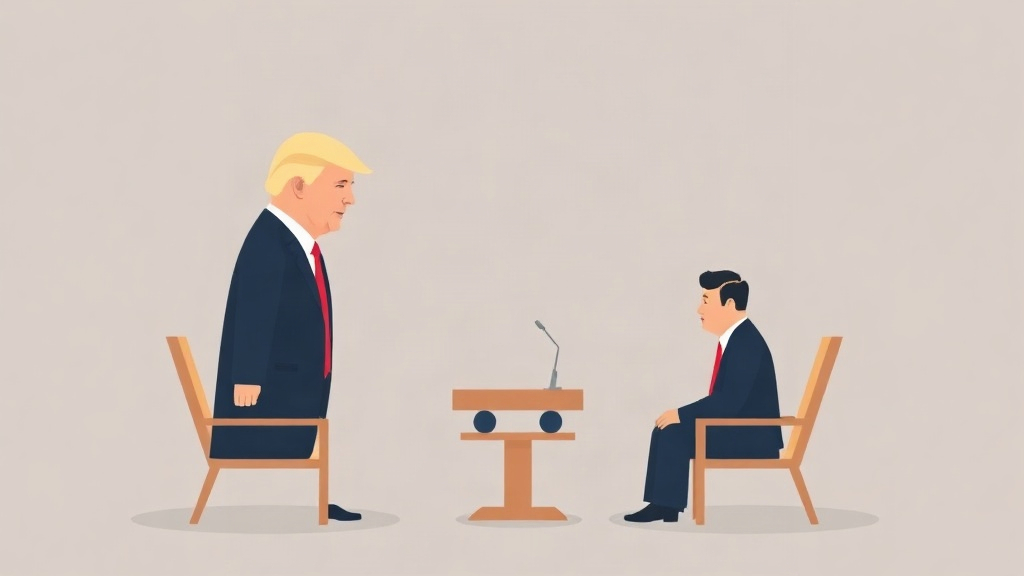
Trump Signs Order Renaming Lake Ontario "Lake America"
President Donald Trump signed an executive order on Thursday renaming Lake Ontario "Lake America," escalating a symbolic front in his deepening trade war with Canada and prompting immediate ridicule from officials on both sides of the border [1].
Standing at the Resolute Desk in the Oval Office — with a large map of the Great Lakes region propped behind him, "Lake America" printed in red lettering above Lake Ontario — Trump declared the change "official, effective immediately" [4]. The order directs the Department of the Interior to update the name within 30 days through the Geographic Names Information Service, the official US repository of domestic geographic names [5].
A Symbolic Strike in a Real Trade War
The renaming is not happening in a vacuum. Trade talks between Washington and Ottawa collapsed late last week, hours before an August 22 deadline, triggering 50% US tariffs on roughly $20 billion worth of Canadian goods [1]. Canada responded with retaliatory tariffs on approximately 700 US products valued at a comparable amount [1]. Trump also threatened additional 50% duties on Canadian steel, trucks, cars, and auto parts to take effect in the new year [4].
Trump framed the renaming as a response to what he characterized as an unfair trade relationship. "Canada has been ripping us off for a long time on trade," he said after signing the order. "Even the military: we defend Canada for nothing" [4]. He also cited a $60 billion US trade deficit with Canada — though economists note it is attributable almost entirely to US oil imports, and that without that exchange the US runs a sizable trade surplus [4]. Trump claimed American farmers face a 400% Canadian tariff; in reality, about 97% of US agricultural exports to Canada enter duty-free under the US-Mexico-Canada Agreement, though certain over-quota dairy products carry Canadian tariffs of up to 300% [4].
Both countries are NATO members with mutual defense obligations under the North Atlantic Treaty, the Ogdensburg Agreement, and numerous other treaties [4].
Canada Pushes Back — Hard
Canadian Prime Minister Mark Carney rejected the order swiftly and pointedly, noting that the name Lake Ontario predates both Canadian Confederation and the US Declaration of Independence by more than 400 years [5]. "We know that America is changing. Their trading relationships, their foreign policies, their national monuments, their hydronyms," Carney wrote on X. "Canadians also know that naming reality means calling it Lake Ontario — then, now and always" [1].
Ontario Premier Doug Ford echoed the sentiment: "It's Lake Ontario to Canadians and the rest of the world. Now and forever" [5]. Nova Scotia Premier Tim Houston was blunter: "We're into some real foolishness now. It's Lake Ontario, buddy" [4]. Canadian Industry Minister Melanie Joly said simply, "We'll always call it Lake Ontario" [5].
The lake's name originates from the Huron (Wendat) Indigenous word "oniatari:io," meaning "lake of shining waters" — a designation that predates the United States as a nation [1]. Four of the five Great Lakes carry names derived from Indigenous languages; Lake Superior is the exception, named after an anglicized French word [5].
Bipartisan Eye-Rolls in the US
Criticism was not confined to Canada. New York Governor Kathy Hochul — whose state is the only US state bordering Lake Ontario — said flatly that New York "won't be calling it that" [4]. Michigan Governor Gretchen Whitmer noted that schoolchildren learn the Great Lakes through the acronym HOMES — Huron, Ontario, Michigan, Erie, Superior — a mnemonic that would need rethinking [4]. Wisconsin Governor Tony Evers mocked the move by filming himself signing a napkin renaming Lake Michigan "Lake Wisconsin," writing, "See, I can sign napkins that say things, too" [5].
Democratic Representative Debbie Dingell of Michigan announced she would introduce legislation in Congress to nullify the order, calling it "idiotic" and describing the Great Lakes as "a shared treasure that generations of Americans and Canadians have worked together to protect" [5].
Even some Republicans were unsparing. Former New Jersey Governor Chris Christie wrote on X: "With all the challenges facing our country, this is what the President chooses to spend his time doing today and communicating to the American people and the rest of the world. Childish. Completely childish" [1]. Former Trump deputy press secretary Sarah Matthews was more colorful still, writing: "I bet this goes so f***ing hard if you're stupid" [1].
Interior Secretary Doug Burgum, by contrast, applauded the move, writing "We're on it, Mr. President!" and stating that US Geological Survey "maps our country for the world to see, and we are PROUD to implement your Executive Order" [5].
A Pattern — and a Preview
Thursday's order follows a template Trump established on the first day of his second term in January 2025, when he renamed the Gulf of Mexico the "Gulf of America" [1]. Mexico has not recognized that change, and the renaming sparked a legal dispute with Google over how the tech giant labels the body of water in its Maps application — currently showing "Gulf of America" for US users and "Gulf of Mexico" for Mexican users [5]. Trump also reversed Barack Obama's restoration of the Alaskan peak's Indigenous name Denali, returning it to Mount McKinley [1].
The Lake Ontario order carries the same legal limits: it applies only to how the US federal government refers to the lake and cannot compel Canada, international bodies, or foreign mapmakers to follow suit [1]. An administration official argued that most of the lake's volume and its deepest point lie within US territory [4].
Trump himself hinted the renaming spree may not be finished. "We have a gulf and we have a lake — now all we need is an ocean," he told reporters. "Maybe we'll have to change the name of the Atlantic and/or the Pacific. Maybe we'll change them both" [4].
What to Watch Next
Despite the theater, there are faint signals that trade negotiations could resume. Canadian trade minister Dominic LeBlanc noted that the US had withdrawn some demands around French-language labeling requirements and confirmed that measures promoting French language and Canadian culture would not face future US trade actions — calling it a potential opening for "a mutually beneficial trade agreement that respects Canadian sovereignty" [5]. Whether that diplomatic thread survives the latest provocation — or whether Trump's ocean-renaming musing moves from joke to executive order — will be the story to follow in the weeks ahead.