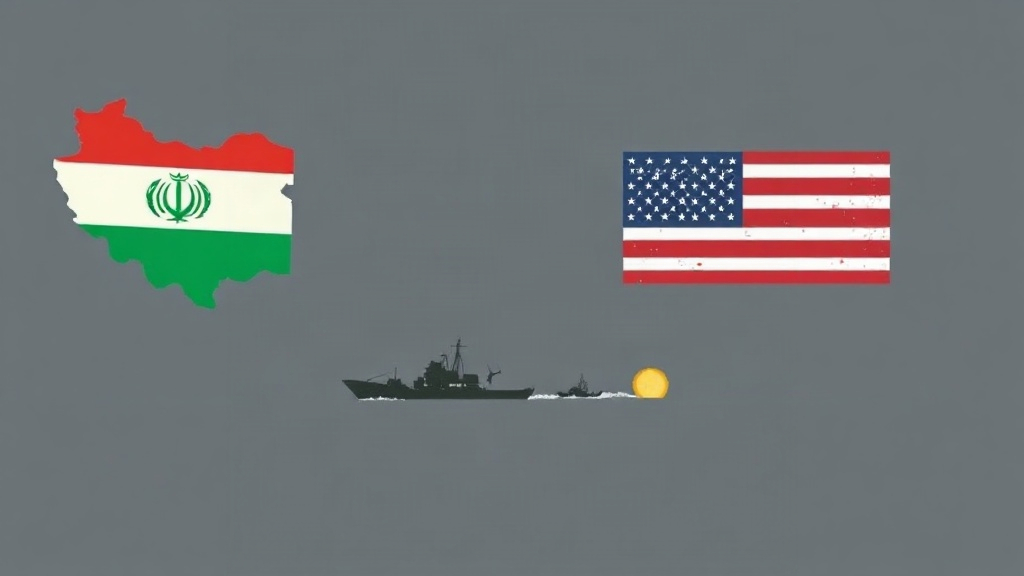
Washington Declares Economic "D-Day" Against Iran
Six months into a war that has produced neither a military nor a diplomatic breakthrough, the United States has launched what Treasury Secretary Scott Bessent is calling "the single greatest financial offensive ever" against Iran [1]. Dubbed "Operation Economic Outcast," the campaign imposes sanctions on nearly 60 entities, individuals, and vessels alleged to be involved in Iranian oil trade, and threatens to cut off from the US dollar system any bank or business worldwide that refuses to sever ties with Tehran [1][3].
The announcement came after a 60-day ceasefire formally expired last week with no settlement in sight, and as Iran continues to choke traffic through the Strait of Hormuz — a chokepoint vital to global energy markets [3]. Only two commercial vessels were reported to have successfully transited the narrow waterway on the day of the announcement, and an oil tanker was reportedly struck by an unidentified projectile near the strait's mouth the following day [1].
Bessent framed the campaign in sweeping historical terms, comparing it to the Normandy landings. "Today, in that same spirit, we are launching an economic onslaught against Iran's financial connections around the globe," he said. "Our objective is to sever every economic lifeline that sustains this tyrannical regime until Tehran stands alone." [1]
China Pushes Back — and the Omission Says Everything
The most telling detail in Washington's opening salvo may be what was left out. Despite Chinese financial institutions playing a central role in financing Iranian oil trade, not a single Chinese bank appeared on the initial sanctions list [1]. When asked why the administration had not moved more aggressively, Bessent offered a candid explanation: "Why would I want to blow up the global financial system?" [1]
China purchases an estimated 80 to 90 percent of Iran's oil exports, a trade relationship it has maintained in defiance of previous US pressure [1][3]. Beijing's response to the new measures was swift and unambiguous. Foreign Ministry spokesman Lin Jian told reporters: "Cooperation between China and Iran has always been conducted within the framework of international law and should not be interfered with or disrupted. China has already stated many times that it firmly opposes illegal unilateral sanctions. China will take all necessary measures to firmly safeguard its own rights and interests." [1]
Bessent did not entirely back away from the China question, telling reporters that "no one was above the reach of US sanctions" when asked specifically about Chinese banks [3]. But financial and trade experts note that the administration is acutely aware of the risks of pushing Beijing too hard, particularly with a scheduled summit between President Donald Trump and Chinese President Xi Jinping set for next month [1]. China's potential retaliatory tools — financial market disruption and restrictions on exports of critical minerals — loom large in Washington's calculations [1].
Analysts Skeptical the Pressure Will Bite
Even before China's formal response, independent economists were tempering expectations. David Oxley, chief climate and commodities economist at Capital Economics, told the BBC the direct impact on Iran's energy revenues would be "somewhat of a damp squib," adding: "We suspect that the new package will have only a limited direct impact on Iranian energy flows in the short term." [3] He pointed specifically to China's historical refusal to recognize US unilateral sanctions as the central obstacle [3].
Ali Vaez, deputy director of the Middle East and North Africa Program at the International Crisis Group, echoed that assessment, arguing that economic pressure on Tehran "doesn't work" because the Iranian regime is willing to "absorb any pain" and pass it on to its population [3]. He noted that while Iran's neighbors — Pakistan, Turkey, and Iraq — want to maintain good relations with Washington, they "can't really afford to cut off ties with Iran" either [3].
Andrew Miller, a senior fellow at the Center for American Progress, was similarly blunt: "The announcement of new economic sanctions on Iran and those countries trading with it signals what is plain to all: this war has brought the United States no closer to eliminating Iran's nuclear programme or crippling the Iranian regime. But while sanctions can be effective, it is highly unlikely they will produce a quick settlement favourable to the United States." [1]
Sina Toossi of the Center for International Policy framed the shift in strategy starkly: "After nearly six months without a military or diplomatic victory, Washington appears to be trying to accomplish through intensified economic strangulation what military force has so far failed to achieve. But Tehran is answering that zero-sum approach with one of its own." [1] This characterization reflects Toossi's analytical framework, not a settled assessment of the campaign's outcome.
Iran Defiant, Allies Diverge
Iran showed no sign of softening. Economy Minister Ali Madanizadeh declared on state television: "Our defence is no longer so defensive; the enemies should wait for an attack." [1] Defense Secretary Pete Hegseth, meanwhile, kept military options explicitly on the table, telling reporters: "By no means are we foreclosing using kinetic strikes anywhere in the strait of Hormuz or around Iran." [1]
Among US allies, responses were mixed. The United Arab Emirates — a close partner of both Washington and Tel Aviv — announced it was suspending trade ties with Iran ahead of the sanctions announcement [1]. The UK expressed support, with Chancellor John Healey welcoming "efforts to increase pressure" while backing a diplomatic solution [3]. Turkey, which has been critical of the US-led campaign, had not yet responded as of Tuesday [1]. India and Russia, both potential targets of secondary sanctions pressure, also remained silent [3].
What to Watch Next
The coming weeks will test whether Washington's economic offensive has more bite than its critics expect — or whether it confirms their skepticism. The Trump-Xi summit next month is now the most consequential near-term variable: whether Trump raises Iran's oil trade directly with Xi, and how Beijing responds, will determine whether "Operation Economic Outcast" remains largely symbolic or escalates into a genuine confrontation between the world's two largest economies. The November congressional elections add further pressure, as the near-closure of the Strait of Hormuz continues to ripple through global oil prices [1]. Any move by major Chinese financial institutions — or any decision by Washington to finally name them — would mark a significant escalation with consequences well beyond the Iran conflict itself.